

looping
or, how to time travel without going anywhere

The days in between Christmas Day and New Year’s Day are often described in trite memes and small talk as “liminal,” “lost,” or just plain “weird.”

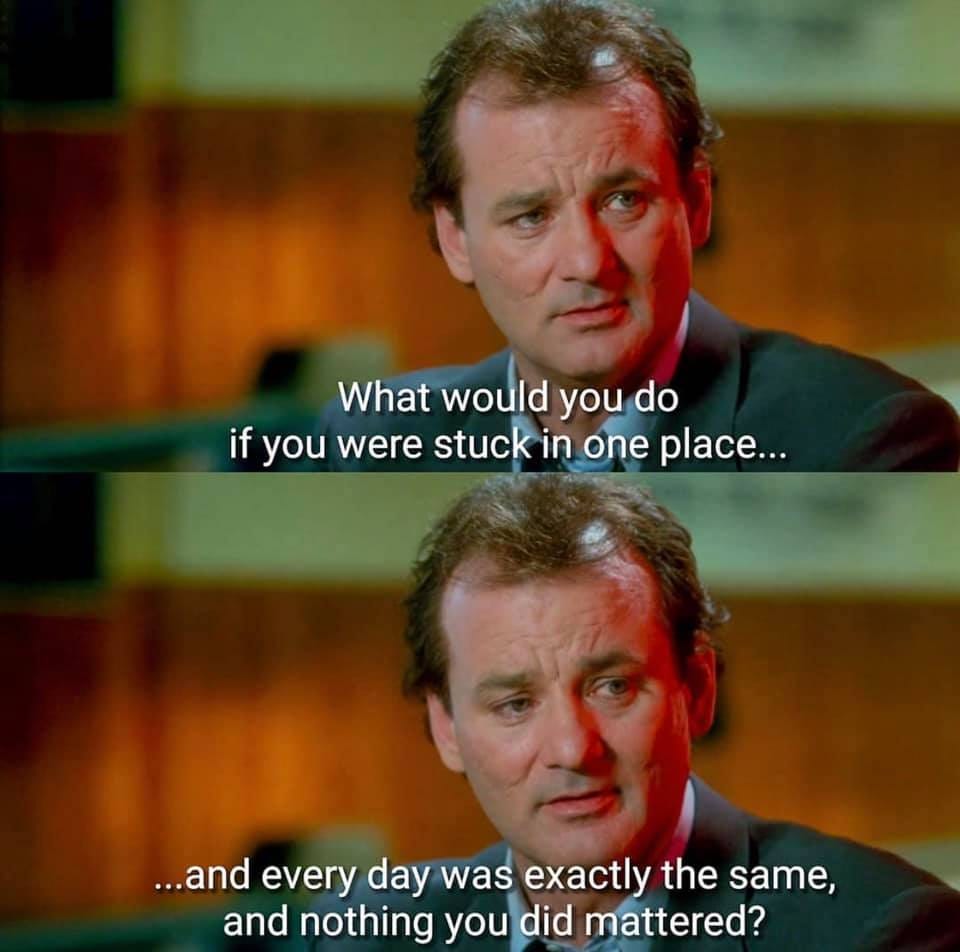
The odd space between the holidays—not quite work, not quite play—begins to dissolve the meaning of time itself (see above).
I found this happening to me, too, as I’m sure it did to so many others this past season. As it’s happened to all of us, many times. I traveled to Utah after Christmas, where every day felt the same, and nothing seemed to mean anything anymore. Trying, in vain, to reinstate some sort of routine, was rather hopeless. In between catching up on sleep and staying up late, everything “normal” in my life got pushed and pulled to strange places. Yes, I still had to work, but not so much that it took up the whole day. Yes, I wanted to exercise and take care of myself, but in unfamiliar ways and at odd times. For all the irregularity that plagued the day, every evening maintained a certain predictability—I spent them with my nieces and nephews, a rollicking, at times exhausting (really only due to my lack of endurance), group. We played games, ate food, worked on several 1,000 piece puzzles. Over and over again.
Day after day felt this way: a futile attempt at reclaiming reality, and then a burst of chaotic energy to send me into the night completely drained. A seemingly endless cycle, repeated, endlessly. It was only when I returned home that I broke myself out of the loop. To be honest, it felt euphoric. There was nothing wrong with how I had spent the previous week, but that fact that it was so repetitious was exhausting.
Around this time, I started to read the beloved indie darling that seems to be on everyone’s reading list, Solvej Balle’s On the Calculation of Volume (Book 1). The concept of the novel and the complete series (six volumes and counting) is that the narrator endlessly re-lives the same day. That’s it—over and over again. In the liminal, irregular, yet predictable last days of the year, I found myself realizing that I was living a version of the novel in my own life. For some reason, the repetitiveness brought about an intense exhaustion. Balle’s narrator, Tara, experiences as much:
“At times, I was overcome by an almost total exhaustion that would suddenly wash over me and plunge me straight into a deep sleep which I would wake from , seemingly without having dreamt, and which segued seamlessly into the incessant collecting and processing of information.”1
Importantly, in On the Calculation of Volume, Tara has been in a sense loosed from and stuck in time. Rather than following time in a linear fashion, her body experiences time in one continuous loop. Time still affects her—she lives in time, experiences a progression of days, etc.—but rather than moving through time, she is trapped in a circuit.
While Tara’s experience is unique, and a thing of fiction, I don’t think the experience is as far-fetched as it might initially seem. Let’s turn to Einstein’s theory of relativity for a brief moment.
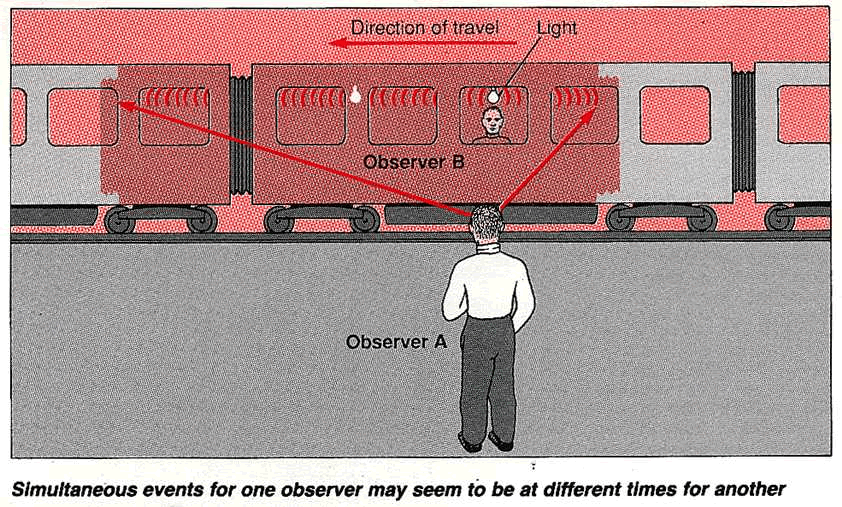
In one of Einstein’s thought experiments used to illustrate the theory, he imagines a train moving in relationship to an embankment where someone is standing, and that lighting strikes embankment twice. Einstein writes, “Are two events (e.g. the two strokes of lightning A and B) which are simultaneous with reference to the railway embankment also simultaneous relatively to the train? We shall show directly that the answer must be in the negative.”2 The observer from the train and the observer from the embankment experience the lightning at different times—that is, in everyday life, we experience simultaneous events in divergent ways from one another, all dependent on individual positioning and frameworks. Experience is not linear, rather, it unfolds for different people dependent on experiences. In a similar way, Tara, and other characters caught in time loops, are experiencing time or simultaneous events, so are we (though at a fraction of the scale).
What is gained, from experiencing these dramatized time loops in literature, movies, and elsewhere? For one, we don’t have to feel alone in our unique experiences of being. Experiencing something in a different way than other people who experienced the exact same thing, or event, or whatever, is not abnormal. It’s a critical part of life, albeit an off-putting and jarring one. Time looping narratives help us understand that one’s own unique experience of temporality is singular—but this singularity is experienced by all.
Moreover, the repetition of time loops more likely than not echoes the true lived experience of day-to-day life. As much as we might dream of or think about wanting to have our lives be unstoppable, unpredictable, and adventure-filled rollercoasters, life moves in unavoidably predictable rhythms. At times, these can feel like enclosures that necessitate escaping. But, as we learn in Groundhog Day, perhaps when we live in the loop long enough, it begins to become the only lived reality, and instead of resisting it, we yearn for the repetition.
We’re past the liminal spaces and times of the holidays but rest assured that these exist everywhere, at all times, all around us. We are in a constant state of moving in and out of the liquid, cyclical nature of time, and yet, irrevocably constrained by its limits.
Solvej Balle, On the Calculation of Volume Book 1
Albert Einstein, “Relativity, the Special and General Theory.”